
Friday, November 14, 2008

Thursday, November 6, 2008
Sunday, November 2, 2008
Why China is so Important
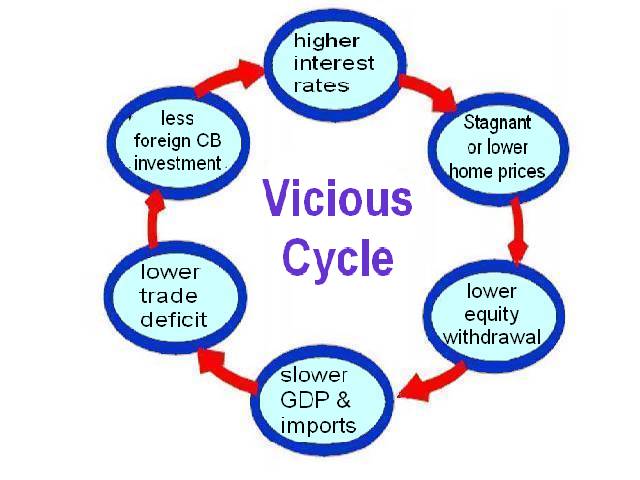
This is from Calculated Risks Blog. Interesting Points.
GDP in the U.S. is now contracting, and imports are falling and the trade deficit is shrinking. And as foreign CB invest less in dollar denominated assets (and also try to stimulate their domestic economies) this could lead to higher interest rates for intermediate and long term U.S. assets. As I noted in 2007, the result could be a vicious cycle with higher intermediate and long term rates further depressing the U.S. housing market and consumption.Although this is very speculative, higher intermediate and long term interest rates in the U.S. for a short period wouldn't be helpful during a recession. This is something to think about as the Chinese economy slows ...
Thursday, October 30, 2008
Tallest Buildings As Leading Indicator

Some five years ago, I recall reading an article on how the construction and completion of each of the world’s tallest building usually coincides with a major equity market collapse. Sadly, I also remember that the article was written in a matter of fact way with no attempt to explain the co-relation.
Works on the Empire State Building began during the euphoric 1920s and finished during the Great Depression. If we are concerned about an upcoming global decline, perhaps we should find out if there are any super-tall buildings under construction?
Guess what? There is. The Burj Dubai, touted as the world’s biggest and tallest is currently under construction in the Persian Gulf city-state. What has happened since construction started? Well, since December last year the Dubai Stock Exchange has lost 54%.
Three landmark buildings in New York City – the Chrysler Building, the Empire State Building, and the Manhattan Company Building (40 Wall Street) – remain as tangible reminders of the enormous ambition and exuberance that characterised the era.
All three buildings were conceived in the bull market and built through the peak, only to open for business amid the worst office-space market in decades.
As each of these buildings were completed, they opened during down-trodden markets.
The signal to sell appears when the tallest building is conceived or begins construction.
Typically, the buildings open for occupation in the “worst of time”, usually in the midst of a major correction. This was proven true again for the Petronas Twin Towers in Kuala Lumpur; the twins were started in 1994 and completed in (you guessed it...) 1997. Need I say more about the co-relation?
The next tallest building was erected in Taiwan; Taipei 101 was scheduled to be completed in 2004. A similar end befell Taiwan in 2004.
Next, it may be Dubai’s turn. The UAE Stock Index collapsed the moment construction started on Burj Dubai, and the magnificent tower is not even completed.
With that, there now appears to be more believers that “tallest buildings” may be a leading indicator; but even as the coincidences appear to be overwhelming, no one has quite attempted to explain the linkages. My explanation is simple. It usually starts from two key traits – excess liquidity and big egos. You will never find countries like the Philippines, Thailand or even Holland planning to erect the world’s tallest buildings.
Certain prerequisites need to be present such as a thriving economy, a period of massive wealth creation (either through real estate/currency/equity markets) and insatiable big egos (you want people to know how well your country/city has done).
In a nutshell, too much money, throw in some big egos and you have a potent mix of problems stirred up pretty nicely.
That spells for an economy/markets/assets that have overshot.
Under construction
Burj Dubai is expected to be an 818m (2,684ft) tall skyscraper. It is currently under construction, and as of May 12 2008, it is 636m (2,086.6 ft) tall, with 160 completed floors. Once completed (projected for 2009) it will be the tallest man-made structure of any kind in history. Currently, there is no man-made structure under construction that could be taller than the Burj Dubai, although there are some proposals.
The 610m (2,001 ft), 150 floor Chicago Spire (formerly Fordham Spire) is currently under construction in Chicago. If completed, it would surpass the CN Tower as the tallest freestanding building in North America, and would be the tallest all-residential building in the world. Construction began in June 2007, and is expected to be completed in late 2010.
The Guangzhou TV & Sightseeing Tower, being built in Guangzhou, is expected to be 610m (2,001 ft) tall. If completed (projected for 2009) it will be tallest concrete tower.
The Jakarta Tower (Menara Jakarta) is a tower that is currently on-hold in Jakarta, Indonesia. Upon completion (projected for 2011), it will stand 558m (1,831 ft.) tall up to the antenna, thus making it the tallest concrete tower.
Russia Tower, in Moscow, stands to be 612m (2,009 ft) high and is expected to be completed in 2012.
The key appears to be when all these towers are completed. When they open, could their respective stock markets have been badly damaged by then?
We need to closely watch the Chicago Mercantile Exchange when the Chicago Spire opens in 2010.
Will a calamity hit down south China when the Guangzhou Tower opens for business in 2009?
Going by the theory on the link between wealth destruction and skyscrapers, thankfully, works on the Jakarta Tower is currently on-hold. The timing of the completion of the Russia Tower in 2012 looks just about right for a correction judging from the current capitalism surge.
Noteworthy is that the Shanghai World Financial Centre has just been completed and in time for the Olympics. But note this – it is greeted by Chinese equity markets that have shed 50% of its value from its high!
Wednesday, October 29, 2008
Bank guarantees causing stock market crash
INTERNATIONAL. Speaking on CNBC, Marc Faber the Swiss fund manager and Gloom Boom & Doom editor and publisher said the stock selloffs in world markets may be partially caused by the fact that many governments increased guarantees for bank deposits, making them a much safer investment.
"Now that deposits are guaranteed, basically I as an investor have no incentive to hold equities so I sell them and put my money in bank deposits," Faber told "Squawk Box Europe", on Monday.
The other measures taken by various governments to try and prop up ailing markets have had the opposite effect, he added.
"The interventions, they actually have increased volatility. It’s impossible to forecast market movements when you have interventions," Faber said.
"If the global economy slows down by as much as I think it will… then a lot of book values will have to be adjusted downward quite substantially," he said.
Chris Whalen from Institutional Risk Analytics makes a similar point in his latest newsletter saying that stock prices no longer represent value and the price confusion is making things worse.
"Price no longer represents value and there’s no reason to trust prices on the stock markets until the 80/20 rule is back in force, where 80% of stocks represent 20% of market volatility", says Whalen.
“The disruption caused by the ground rules shift is visible in all aspects of business and finance,” Whalen writes.
Faber's conclusion? "I think first we’ll have a bout of deflation that will actually be quite substantial… but then the budget deficits will go through the roof and the Fed will print even more money … and then later on we'll have very high inflation."
"Now that deposits are guaranteed, basically I as an investor have no incentive to hold equities so I sell them and put my money in bank deposits," Faber told "Squawk Box Europe", on Monday.
The other measures taken by various governments to try and prop up ailing markets have had the opposite effect, he added.
"The interventions, they actually have increased volatility. It’s impossible to forecast market movements when you have interventions," Faber said.
"If the global economy slows down by as much as I think it will… then a lot of book values will have to be adjusted downward quite substantially," he said.
Chris Whalen from Institutional Risk Analytics makes a similar point in his latest newsletter saying that stock prices no longer represent value and the price confusion is making things worse.
"Price no longer represents value and there’s no reason to trust prices on the stock markets until the 80/20 rule is back in force, where 80% of stocks represent 20% of market volatility", says Whalen.
“The disruption caused by the ground rules shift is visible in all aspects of business and finance,” Whalen writes.
Faber's conclusion? "I think first we’ll have a bout of deflation that will actually be quite substantial… but then the budget deficits will go through the roof and the Fed will print even more money … and then later on we'll have very high inflation."
Subscribe to:
Posts (Atom)


